Pro Rata Consumption in Electricity Bills – A Practical Guide for Consumers
As a field officer working in the electricity sector for years, I’ve seen how certain terms on electricity bills leave people confused. One of those is “Pro Rata Consumption.” Many customers think it’s some hidden overbilling tactic. Let me clear up this misunderstanding and explain exactly what is this and why it exists, and how it affects your electricity bill.
What Does Pro Rata Consumption Mean?
In simple words, “Pro Rata” is a Latin term that means “in proportion.” When it comes to electricity bills, it refers to how your usage is calculated when your billing period isn’t exactly 30 days.
Electricity bills in Pakistan are supposed to be calculated over a standard 30-day period, as per NEPRA’s rules. But in reality, the number of days between two meter readings can vary due to holidays, weather, workforce issues, or operational reasons. Sometimes, a meter reader might visit after 28 days; other times, it could be after 33 days.
This variation creates a problem: if you’re billed for fewer or more days without adjusting the calculation, your monthly charges might be unfairly high or low. That’s where pro rata consumption comes in—it adjusts your bill proportionally so that you’re only charged for the days you used electricity.
How It Works?
Here’s how it works in practice:
- Suppose your last reading was on April 1st, and the next reading is taken on May 5th. That’s a billing period of 35 days.
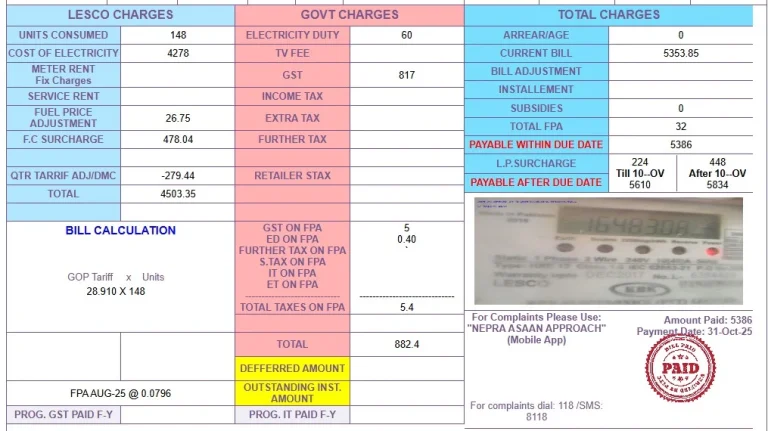
- Under normal circumstances, your bill should reflect consumption for 30 days. So, the billing system uses a calculation to divide your total consumption into a daily average and then multiplies it by 30 days to generate your bill amount.
It’s the same if your billing period is shorter than 30 days—the system adjusts upward so you’re not under-billed.
Think of it like dividing a pizza fairly among friends. Whether you cut it into 6 slices or 10, each person gets the same proportion they deserve.
Why Pro Rata Is Not Overbilling?
A big misconception among consumers is that it is automatically means overbilling. That’s not true.
In fact, it’s the opposite. Pro rata billing helps ensure that every consumer pays only for what they have used—no more, no less. Without this adjustment, people whose bills cover extra days might end up paying more than their fair share, while those with fewer days might pay too little.
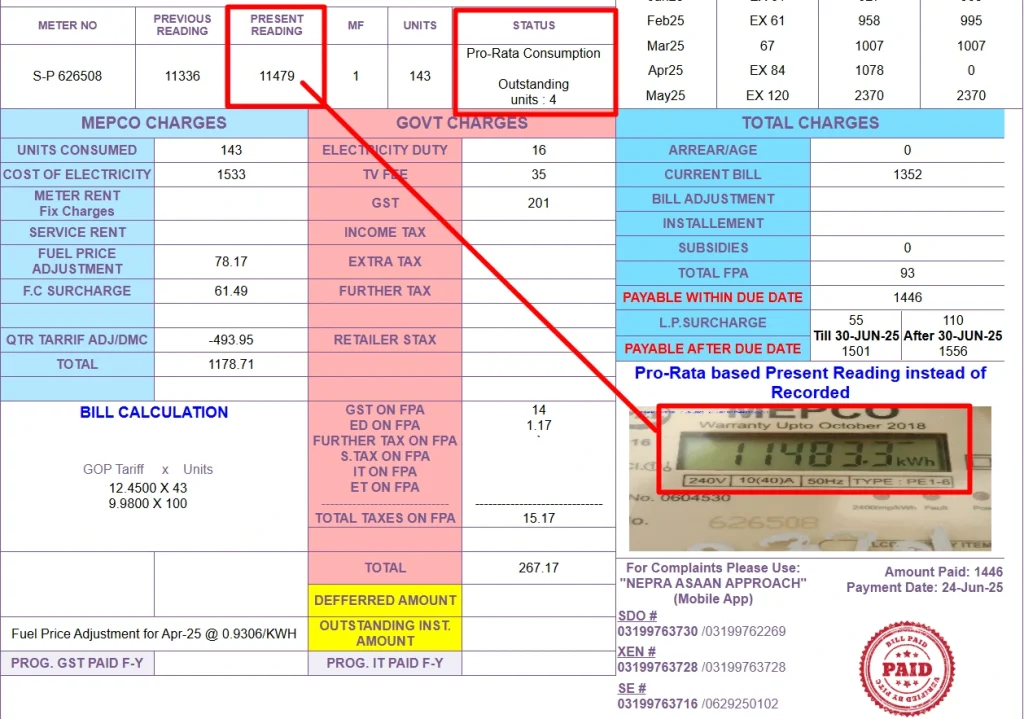
For example:
- If your billing cycle was 32 days instead of 30, your units would be scaled down to match the 30-day standard.
- Conversely, if it was 28 days, your units would be scaled up slightly so that the utility company recovers its costs evenly over time.
This system keeps billing fair across all consumers.
Seasonal Impact on billing Categories (protected & non-protected)
One important impact of pro rata is how it affects protected consumer categories.
In Pakistan, domestic consumers using low units fall under the protected category, enjoying subsidized rates. However, if the billing period changes—say, from 28 days to 33 days—it could temporarily push a consumer into a higher usage slab, shifting them out of the protected category.
For instance, MEPCO reported that out of over 6.7 million domestic users, only around 0.73% were affected by shifting into the non-protected category because of pro rata adjustments. So while the impact exists, it’s statistically minimal.
Pro Rata Beyond Electricity
Pro rata isn’t unique to electricity. It’s a common calculation in:
- Insurance (partial-term premium payments)
- Dividends for shareholders
- Subscription services (like charging for partial months)
The concept is always the same: ensure everyone pays a fair share for the portion of a service or product they actually use.
Conclusion
Pro rata consumption is there to protect you—not exploit you.
Instead of overbilling, it makes sure you pay fairly, even when your billing days vary. If you notice a slight difference between your meter reading and the units billed, it’s often because pro rata adjustments were made to keep your charges accurate and in line with regulatory rules.
So next time you see “Pro Rata” on your bill, remember: it’s simply the system working to ensure fairness for every customer.
If you ever feel uncertain about your bill, reach out to your local electricity office. As field officers, we’re always ready to help you understand how your charges are calculated and ensure you’re only paying for what you’ve truly used.